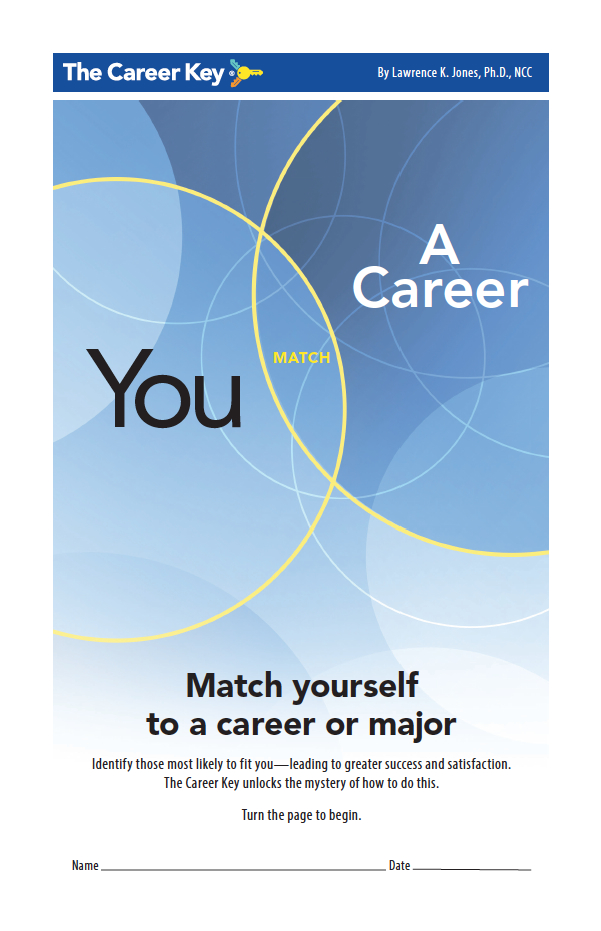
The assessment, based on Holland's Theory of Career Choice, helps middle and high school students make sense of career choices and choosing classes by identifying careers that match their personality and interests. Research shows this match leads to higher levels of engagement, satisfaction and success.
Career blog about career well-being and the education pathways to meaningful careers.
Monday, September 28, 2015
New College and Career Readiness Infographic from Career Key
Career Key's new college and career readiness infographic shows the American School Counselor Association's (ASCA) new ASCA Mindsets and Behaviors for Student Success
covered when students take the Career Key's career interest inventory. Counselors can use the infographic to easily visualize how their use of Career Key aligns with these research-based standards.
Sunday, August 2, 2015
New Career Key Test and Activity Booklet Published
We just reprinted and updated the Career Key Test and Activity Booklet, now available for sale on Amazon. (Free shipping!) They cost about $2 apiece and are sold in sets of 35 booklets.
These booklets are perfect for when you need an easy, printed activity that covers the career essentials for students and adults in classes and workshops...
The 20 page, color booklet includes the self-scoring Career Key test, a description of Holland's Theory of Career Choice including the hexagon, and recommended activities with worksheets to further engage in the career exploration process, like:
These booklets are perfect for when you need an easy, printed activity that covers the career essentials for students and adults in classes and workshops...
The 20 page, color booklet includes the self-scoring Career Key test, a description of Holland's Theory of Career Choice including the hexagon, and recommended activities with worksheets to further engage in the career exploration process, like:
- Learning more about occupations
- Learning more about yourself
- Creating a career portfolio, and
- How to make a good decision.
Friday, July 31, 2015
Find your academic tribe! July's Free Agent, the Career Key Newsletter
Is helping others find their academic tribe, the right college major environment on your Fall list for working with high school or college students? Good for you - research says it's worth the extra time to delve into. To read the feature article about it, visit the July 2015 issue of our enewsletter, The Free Agent. Be sure to subscribe on Career Key's home page, www.careerkey.org, if you like what you see.
The newsletter has Career Key news, humor, and research you can use. There are links we've come across we think are worth sharing, in addition to free downloads. Enjoy!
Monday, November 10, 2014
Recent Career Development Research on Physical Disabilities
In honor of National Disability Employment
Awareness Month and Veterans Day November 11, I gleaned some practice tips from recent research studies on physical disability
and career development.
The goal is to inform and link career development practitioners working
with disabled clients to research and resources they may not be aware of.
Why should we pay attention to disability in career development?
- In 2005, one in five U.S. residents reported some level of disability (U.S. Census 2008) with the number rising with large numbers of returning veterans.
- Individuals with disabilities comprise the largest minority group in the United States, with almost half the population living with one or more chronic health conditions. (Foley-Nipcon and Lee, 2012)
Finding: Severity of the
disability and age of disability onset matters
When counseling physically disabled individuals, “the
perceived severity of the disability and the point in the life span at which it
occurred are not negligible details…”*
Study authors found that:
- Disability severity and age of onset significantly relate self-efficacy with Realistic, Artistic, Social and Conventional domains. Only the Investigative domain had insignificant relation – perhaps because of its focus “on mental tasks performed alone and that require minimal physical mobility."
- “[S]elf-rated disability severity does not have a detrimental relation with vocational self-efficacies among those who become disabled early in life.”
- By contrast, “individuals who become disabled later in life show a steeply negative relationship between self-rated disability severity and self-efficacies.”
*Tenenbaum, R. Z., Byrne, C. J., and Dahling, J. J. (2014). Interactive Effects of Physical
Disability Severity and Age of Disability Onset on RIASEC Self-Efficacies, Journal of Career Assessment, Vol. 22(2)
274-289. Note: this study did not include anyone with blindness. Please see any other limitations the authors list.
This study supports recommendations in the diverse
populations chapter of NCDA’s Career Development
Facilitator “Facilitating Career Development: Student Manual (Rev. 2nd
Edition). It recommends that practitioners consider when in the lifespan the
disability occurred – taking into account possible feelings of loss, guilt and
grief.
Additional resources:
National Career Development Association website’s List
of Resources for People with Disabilities
Eby, L. T., Johnson, C. D., & Russell, J. E. A. (1998).
A psychometric review of career assessment tools for use with diverse
individuals. Journal of Career Assessment,
6, 269–310.
Feldman, D. C. (2004). The role of physical disabilities in
early career: Vocational choice, the school-to-work transition, and becoming
established. Human Resource Management
Review, 14, 247–274.
Foley-Nicpon, M., & Lee, S. (2012) Disability research
in counseling psychology journals: A 20-year content analysis. Journal of Counseling Psychology 59,
392–398.
Peterson, D. B., & Elliott, T. R. (2008). Advances in
conceptualizing and studying disability. In S. D. Brown & R. W. Lent
(Eds.), Handbook of counseling psychology
(4th ed., pp. 212–230). Hoboken, NJ: John Wiley & Sons Inc.
If you know of other research or resources I have not included, please leave a comment and I will add it to the post.
Thursday, November 6, 2014
4 Ways Veterans Can Successfully Make the Military to Civilian Transition
To celebrate Veterans Day on November 11, Career Key recommends four strategies veterans can use to make a successful military to civilian transition. They are:
Take action now by:
- Evaluate your readiness to make a career decision
- Use the 4 S's Transition Model for a little structure and self-assessment: Situation, Self, Supports, and Strategies
- Explore and narrow career options to personality-career matches using Holland's Theory, and
- Follow the 4-step ACIP decision making model.
Take action now by:
- Evaluating your readiness to make decisions using the Career Decision Profile.
- Visiting this short slideshow that explains the 4 S Transition Model and asking yourself questions about the 4 S's.
- Learning about how to match your personality with career options
- Download a free Decision Balance Sheet and watch a short video about decision making at the Career Key website.
Tuesday, September 30, 2014
New Fanshawe College Pathfinder Uses Career Key's Career and College Major Test
We're proud to announce that Fanshawe College, one of the largest colleges of applied art and technology in Ontario, is now using The Career Key's valid career and college major test to match prospective students to Fanshawe's programs of study. The online Fanshawe Pathfinder is the first college recruitment and admissions tool in Canada and the U.S. to use Personality-Major MatchTM. The Pathfinder gives students valuable information in choosing a program that fits them best and how to make a successful education decision.
Large published research studies show a close personality-major match predicts higher grades, greater persistence in a major, and higher rates of on time graduation. The benefits of this match are described in a free Career Key eBook, Choose a College Major Based on Your Personality.
Fanshawe licensed The Career Key to create the Pathfinder for their admissions and recruitment efforts. The Pathfinder will also be used in academic advising for current students and featured in public open houses and career fairs.
Large published research studies show a close personality-major match predicts higher grades, greater persistence in a major, and higher rates of on time graduation. The benefits of this match are described in a free Career Key eBook, Choose a College Major Based on Your Personality.
Fanshawe licensed The Career Key to create the Pathfinder for their admissions and recruitment efforts. The Pathfinder will also be used in academic advising for current students and featured in public open houses and career fairs.
About Fanshawe
Fanshawe’s main campus is located in London, Ontario, about
two and half hours outside Toronto. Approximately 17,000 full-time and 26,000
part-time students attend Fanshawe at five campuses. Fanshawe has a demonstrated commitment to student success. Results of the Government
of Ontario’s 2013 Key Performance Indicators (KPI) survey show that Fanshawe
College is above the provincial average in student satisfaction, graduate
satisfaction, and graduate employment (86% of graduates find jobs shortly after
graduation). To learn more about Fanshawe, visit Discover Fanshawe.
Wednesday, September 17, 2014
What the Walmart VP Termination Over a Resume Teaches Us
Yes, it teaches us not to lie on our resume, not to leave a
misimpression or omission about our credentials. But why did Walmart’s former
Vice President of Communications David Tovar feel the need to demonstrate
he graduated from college? I can’t
speak for him but we know the answer… it’s because he needed the degree. You
need to graduate from college if you want to make a living wage working for
someone else. Like most employers, Walmart will not hire you for salaried sales or management without a college degree (example).
I’ve been reading Michael Ellsberg’s The
Education of Millionaires: Everything You Won’t Learn in College About How to
Be Successful and other anti-college writing. The common position is that people do not need a college degree, pointing to many rich, entrepreneurial
people as examples (High-tech company founders, information sales people, etc).
And while I found I agreed with Ellsberg on many practical things
that are wrong with higher education (and he has some great networking tips), the anti-college argument ultimately fails
as a good career planning approach.
First, a college degree or postsecondary training credential
is necessary for most living-wage employment in this country; the
statistics about unemployment and salaries do not lie. One reason employers require a
college degree or post-secondary training credential in hiring is because it’s an
easy way to screen people out, to narrow the hiring pool. So many people are looking for jobs;
employers can afford to be picky. Also, minimum job qualifications like an
educational degree are legally necessary in a world where equal rights laws
guard against discrimination. So does it really make sense to voluntarily cut
yourself off from millions of jobs?
The anti-college crowd argues that you can creatively sell
yourself into a job and if that doesn’t work (that employer must be an
unimaginative boob), then start your own business. Having been happily
self-employed myself at one time, I get the freedom, flexibility and success that
can give you.
But self-employment and entrepreneurship is not for
everyone. Not everyone has a strong Enterprising
Holland personality type, someone who likes to and is good at persuading,
leading, and selling things or ideas. Or is an extrovert.
And while I agree with Dan Pink and many others that sales skills are needed in
nearly every job now, to advise young people that a college degree is
unnecessary, substituting sales and marketing skills through self-employment,
is a naïve oversimplification of our work world. That's as bad as saying a college degree = a high-paying job.
Self-employment
should always be a fallback option, if not a promising option for some. Having
practiced labor and employment law for 10 years, I think people should be
prepared, as a matter of emotional and financial survival, to be out of a job
at any time, for any reason. But being prepared also means having proof of skills and education to support a job search.
Instead of warning people away from college degrees entirely,
we can start by helping people approach their college years in smarter ways – identifying
majors and programs of study that match their interests and Holland personality,
learning more marketing skills, seeking out experiential education programs
that don’t require an unpaid internship (that only wealthier parents can afford
to subsidize), and adopting a flexible, free
agent approach to the world of work.
Subscribe to:
Posts (Atom)