Career Key

Author: Career Key's President and CEO, Juliet Wehr Jones, GCDF, J.D.
Showing posts with label School Counseling. Show all posts

Monday, September 28, 2015

New College and Career Readiness Infographic from Career Key

Career Key's new college and career readiness infographic shows the American School Counselor Association's (ASCA) new ASCA Mindsets and Behaviors for Student Success covered when students take the Career Key's career interest inventory. Counselors can use the infographic to easily visualize how their use of Career Key aligns with these research-based standards.
College and career readiness

The assessment, based on Holland's Theory of Career Choice, helps middle and high school students make sense of career choices and choosing classes by identifying careers that match their personality and interests.  Research shows this match leads to higher levels of engagement, satisfaction and success.

Sunday, August 2, 2015

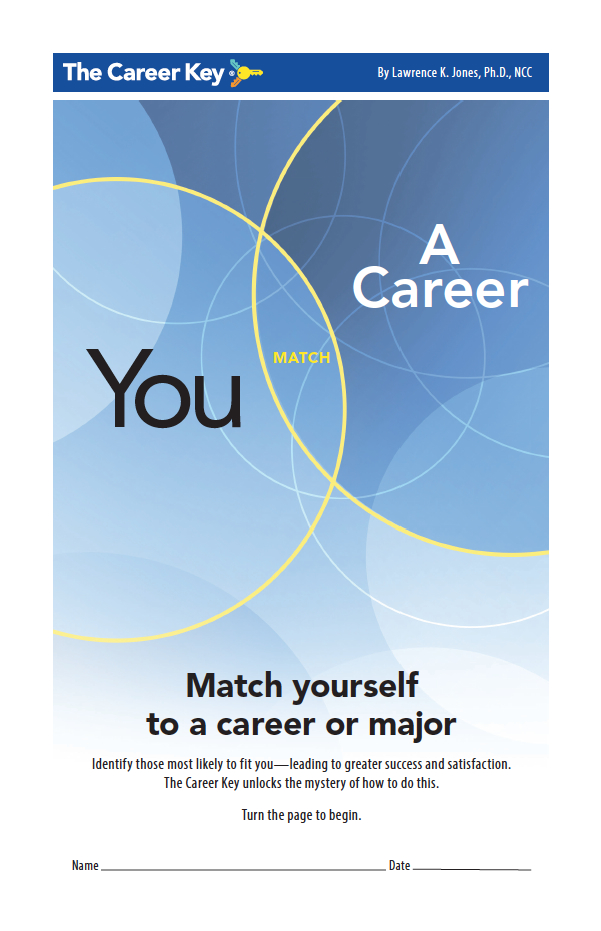
New Career Key Test and Activity Booklet Published

We just reprinted and updated the Career Key Test and Activity Booklet, now available for sale on Amazon. (Free shipping!) They cost about $2 apiece and are sold in sets of 35 booklets.

These booklets are perfect for when you need an easy, printed activity that covers the career essentials for students and adults in classes and workshops...

The 20 page, color booklet includes the self-scoring Career Key test, a description of Holland's Theory of Career Choice including the hexagon, and recommended activities with worksheets to further engage in the career exploration process, like:
  • Learning more about occupations
  • Learning more about yourself
  • Creating a career portfolio, and
  • How to make a good decision.

Friday, July 31, 2015

Find your academic tribe! July's Free Agent, the Career Key Newsletter

Is helping others find their academic tribe, the right college major environment on your Fall list for working with high school or college students? Good for you - research says it's worth the extra time to delve into. To read the feature article about it, visit the July 2015 issue of our enewsletter, The Free Agent.  Be sure to subscribe on Career Key's home page, www.careerkey.org, if you like what you see.

The newsletter has Career Key news, humor, and research you can use.  There are links we've come across we think are worth sharing, in addition to free downloads.  Enjoy!

Wednesday, June 4, 2014

Choose a Career and College Major with Holland's Theory, New Career Key Video Series

Learn how to choose a career or college major with Holland's Theory of Career Choice in a new YouTube video series "How to Achieve Career and College Success" from Career Key.

These short videos cover Dr. John Holland's six main ideas, including the Holland personality types (also known as Holland codes), Holland's work and education environments, and how to use the Holland hexagon. It's based on the popular Career Key web article on Holland's Theory of Career Choice.

How to Achieve Career and College Success Video Series

  • How to Achieve Career and College Success: Introduction
  • The Six Holland Personality Types
  • The Six Holland Environments
  • Holland Environments: searching for and interacting with them
  • The Holland Hexagon
  • Congruence: Making a Good Match

The series is created and presented by Career Key author and nationally recognized counseling psychologist, Dr. Lawrence K. Jones, NCC. It is followed by a series on good career decision making.

All these videos will appear soon in a new section of the Career Key website.

Subscribe to The Career Key's YouTube channel to get notified of new videos as they appear.

Friday, May 9, 2014

New College and Career Readiness Kit for School Counseling

Career Key's new college and career readiness kit is complimentary, designed for school counselors and other education and career development professionals. In this downloadable kit, we included free eBooks and learning activities related to helping students get college and career ready.


Topics covered:

  • Common Core Standards and school counseling
  • Choosing a college major in high school
  • Learning activities that combine ASCA and Common Core Standards
  • Meeting ASCA National Standards using career and college major exploration activities at the Career Key website.
Finally, there is a link to access a free trial of the Career Key career and college major test (a $150 value).

Related articles:

Wednesday, March 5, 2014

Holland Personality Type Patterns That Are Inconsistent - and Their Advantages

One part of using Holland's Theory of Career Choice to choose a career is the concept of choosing a compatible work environment, one that matches your strongest personality types. Most people are a combination of types, most often found close to one another on the Holland Hexagon. The hexagon shows the relationship between the types - the closer they are to one another, the more compatible.

But what if your strongest personality types are opposite each other on the hexagon, like Realistic-Social (RS) Investigative-Enterprising (IE), or Conventional-Artistic (CA)? These are sometimes referred to as inconsistent personality patterns. But don't be alarmed.

While these combinations are less common, they are normal. In fact, Career Key's author Dr. Lawrence K. Jones has an inconsistent pattern himself: Realistic-Social. His personal story also shows these characteristics.

To learn more about understanding and taking advantage of these kinds of personality type combinations, visit Career Key's articles:

If you're new to Holland's approach, then start with our Holland's Theory of Career Choice article. We plan on adding a short video about inconsistent personality patterns soon to Career Key's YouTube channel so please subscribe if you want to be notified when that comes out.

Is College Worth It? 6 Ways to Increase Chances of Success in College

More students and parents are asking themselves, is college is worth it? A recent Pew study visualized in TIME magazine finds more people questioning college's value, and yet statistics are clear that it is. The Federal Reserve Bank of New York's 2014 report, "Are Recent College Graduates Finding Good Jobs?" shows compelling reasons to go to college. But the report raises valid concerns about underemployment after graduation and the differing value of certain college majors and skills in the labor market.

Like anything else, research and planning ahead give a big payoff in these types of life decisions.  In Career Key's new website article"Is College Worth It?", counseling psychologist Dr. Lawrence K. Jones, NCC looks at whether people are getting good jobs after graduation based on the latest statistics. Then he recommends how people can increase their chances of success after college graduation.

These recommendations include:

  1. Choose a major that matches your personality and interests.
  2. Consider choosing a major in high school before you choose a college.
  3. Be open to choosing a good job that does not require a 4 year degree.
  4. Have realistic employment expectations; Underemployment is a reality you may have to face.
  5. Be smart and make good decisions about your education plans using an effective decision making process.
  6. Be aware of how the nature of work is changing and plan ways you can respond and adapt.

For more about why college is worth it and what's behind these recommendations, visit Career Key's Choose a College Major section and "Is College Worth It?"

Tuesday, January 28, 2014

Help Choosing a Major Needed More Than Ever


Statistics show that students need help choosing a major now more than ever.  The November 2013 ACT College Choice Report found that only about one-third (36%) of college bound students taking the ACT are choosing majors that fit their interests or Holland personality. And we know from personality-major match research, this will very likely negatively impact these students' success.

Research shows that students who do choose a major that fits their personality and interests, what we call a close “personality-major match,” are more likely to succeed in college with:
(1) higher grades;
(2) greater persistence in a major; and
(3) higher on-time graduation rates.

College completion rates continue to be low. According to the U.S. Department of Education, only 38 percent of students entering a 4 year college graduate in 4 years, 59 percent in six. About 40 percent drop out. (National Center for Education Statistics, 2013).

And there is a steep financial penalty to those who switch majors and delay graduation.  One study showed that those working toward a bachelor’s degree lose in earnings, on average, $50,000 (adjusted for inflation) for each additional year it takes to finish their degree.  In addition, many studies support increased salary and job satisfaction for people who choose a career that matches their personality.

So how can students make better decisions about majors? Career Key has several affordable resources students can use to make good education decisions:
Match Up! EBook, available in the Career Key Store
  1. Free eBook downloads: “Choosing a College Major Based on Your Personality: What does the research say?” We also have a special Professionals’ Guide to Personality College Major Match and Student Success for counselors, career development professionals, and educators.
  2. Career Key's unique eBook, Match Up! Your Personality to College Majors and Training Programs 2014. Used with results of the Career Key career test, it offers the only complete list of U.S. and Canadian majors and programs of study scientifically classified by Holland personality type – enabling a close personality-major match.
  3. Self-help articles like What is a College Major, Personality Major Match, Holland College Major Environments, and What are Liberal Arts Majors.

Thursday, December 19, 2013

Common Core Standards and School Counseling

Why are Common Core Standards important to school counselors?  How do they relate to ASCA Standards?  Career Key answers these questions in a new website guide, "Common Core and ASCA Standards, School Counselors and Career Key."


Career Key's author and counselor educator Dr. Lawrence K. Jones, NCC has written this guide to help school counselors collaborate with teachers in getting students career and college ready. Free resources include:

  1. "Common Core State Standards: A Challenge and Opportunity for School Counselors." PDF eBook;
  2. "Help Middle School Students Get Career/College Ready with Holland's Theory." Webinar recording (12/13/13) with Dr. Jones and myself. 100% of feedback survey respondents would recommend it to a colleague.
  3. Learning Activities with Overlapping ASCA National Model and Common Core Standards, PDF Download; and
  4. ASCA and Common Core Standards Addressed in Career Key Test Taking Scenario, PDF Download.
For more, visit our school counseling resources page at the Career Key website.

Monday, November 4, 2013

New Career Key Career Test Booklet Available

Career Key's popular career test is now available in a printed booklet form, the Career Key Test and Activities Booklet! Sets of 35 cost $75 (about $2 per booklet) and are available for sale on Amazon.com and in the American School Counselors Association bookstore.


This 20 page booklet includes Career Key's scientifically valid career interest inventory as well as activities covering career development's most important concepts, such as how to make a good decision. At the Career Key website, there is also a free PDF guide to using the Career Key Test and Activities Booklet to meet ASCA's National Model Student Standards.

Released with a new design and content in September 2013, it is full color and environmentally friendly, made with 100% recycled bright white paper and soy inks.

Free shipping and more sample pages are available at the booklet's product page on Amazon.com.

Thursday, September 6, 2012

Tips for Using College Navigator: New Career Key Video

On Career Key's YouTube channel, this new tutorial helps students and adults returning to school find schools that offer the college majors that interest them, using the U.S. Department of Education's College Navigator website.

Once students have narrowed their choices to college majors that match their strongest Holland personality types, they can use College Navigator to find schools that offer those majors.

College Navigator offers a variety of ways to filter searches for colleges and universities - by college major and program of study, zip code, to test scores to name a few. The site also has no ads and no "pay to appear" listings, making it a trustworthy resource.

Similar links that may interest you:
Career Key's YouTube channel playlist: Career Key Tutorials and Demos
Career Key's YouTube channel playlist: Top College Majors Resources: Tutorials
Personality-College Major Match: Why It is Important

Tuesday, August 21, 2012

Career Key's College Majors E-Book: New Video Demo


For students, adults returning to school, and parents looking for help choosing a college major or training program, spend a couple minutes on Career Key's YouTube Channel for a short video overview of our "Match Up Your Personality to College Majors" eBook.

Although this eBook has a lot in it (1,400 college majors and training programs and their descriptions, scientifically classified by Holland personality type and Career Key work group), it is very easy to navigate with Adobe Reader. Click on the video below to watch now:


Soon we will be uploading more short videos with tips for getting the most out of this "Match Up" eBook and using College Navigator to find colleges and universities that offer the college majors and programs that interest you.

Thursday, August 16, 2012

Career Key Career Test Overview Video

Career Key's YouTube channel now features a video overview of The Career Key career test. Take two and a half minutes to watch if you'd like to learn more about our valid career test or you are a new user who wants to get the most out of the experience:


If you are a Career Key career test group discount customer, feel free to share the link with your test takers as a quick introduction.

I plan on adding to our Career Key Demos and Tutorials video playlist so feel free to suggest more ideas...

Monday, June 25, 2012

College and Career Success: Is Your State a Leader or Laggard?

Promising careers require some post-high school training and education; students and parents need to be educated consumers. While there is a lot of criticism about graduation rates and unsavory recruitment practices at for-profit colleges, there is plenty of criticism to go around for public colleges' performance.

The U.S. Chamber of Commerce's Institute for a Competitive Workforce (ICW) just released its "Leaders and Laggards" State-by-State Report Card on Public Postsecondary Education.  Be sure to click on your state's individual report card and overall recommendations.

You can see a summary of findings on the Career Tech Blog - these are the three that stuck out the most to me:

"Four-Year Completion Rates
In most states, only half of students at four-year public colleges complete a degree, in 17 states, less than half of all first-time bachelors-seeking students complete a degree within six years";

"Two-Year Completion Rates
...more than half of states have a two-year completion rate at or below 25 percent"..: and

"Linking Postsecondary Data to Labor Market
Only 22 states have systems in place to track the success of graduates once they enter the labor force and to make those data public..."


While others focus on big-picture, long-term, bureaucratic change (good luck!), I'm more focused on how we can help individual students, parents, and counselors improve their chances of success now. The best practical takeaway from this report is for students and parents to learn their state's strengths and weaknesses in providing education. If nothing else, you'll know what to look for and avoid, and what to expect as far as your state's performance. And when you go through the process of choosing a school or program, you'll know to ask for more information about graduation rates and support for students looking for a job post-graduation.

I don't know that I've given up on government for problem-solving (or trust the for-profit sector to do it either) - but it's clear to me that if you are or have a child in secondary school or college right now, it's up to you to help yourself choose a career or college major you won't regret. Gathering the best quality information you can is part of making good decisions.


Friday, February 3, 2012

Personality-College Major Match Research in NCDA's February Career Convergence

The National Career Development Association (NCDA) looks at "personality-college major match" in the February issue of its web magazine Career Convergence, in the feature article, "Research Reveals that Personality-Major Match Strengthens Students' College Success."  In it, Career Key author Dr. Lawrence K. Jones, NCC describes the impact that personality and Holland's college major environments have on college performance.

The article also refers to two important, free white papers in an e-book format that explain the research and how to apply it to career and education decisions:


Tuesday, December 13, 2011

Career Clusters, Career Pathways & Our Updated E-Book

"5 Steps to Choosing a Career Cluster, Field, or Pathway" has just been updated. It includes the most recent updates to The Career Key test and the most recent assignments of Career Clusters and Career Pathways found on O*NET OnLine.

Found in our eBookstore, "5 Steps" costs $9.95 with a special discount for purchasing both the Career Key test and the e-Book together.

Career Key's approach is to use its valid assessment of Holland's six personality types to match students to occupations, then to the clusters and pathways related to those occupations.

Our e-book is the only one that matches students' interests in this way. We also have a free online article called "Choosing a Career Cluster, Field or Pathway" with a free downloadable Career Key Map of the 16 Career Clusters.

The 16 Career Clusters and 79 Career Pathways are not organized by interests (but by industries and required skills, knowledge). So it's important to give students a scientifically valid way to match their interests to occupations within those clusters and pathways.

I uploaded to YouTube a video overview of Career Key's Career Clusters and Career Pathways resources, including the new version of the e-book.


If you are interested in Career Clusters and Career Pathways, you might read these related blog posts:
Career Clusters Interest Survey Validity Questioned by Study
NCDA Article on Using Interests to Organize Matching College Majors, Career Clusters and Pathways
NCDA (National Career Development Association)

Please see the related press release, "Career Key's Updated e-Book Enables Students to Choose the Best Career Cluster and Career Pathway."

Tuesday, July 26, 2011

Make Career and College Major Decisions Based on Research: What we might learn from Bill Gates


Given our obsession with using research to help students make better career and college major decisions – this particular quote stuck out to me from Bill Gates’ Wall Street Journal interview last weekend, “Was the $5 BillionWorth It?:

"I bring a bias to this," says Mr. Gates. "I believe in innovation and that the way you get innovation is you fund research and you learn the basic facts." Compared with R&D spending in the pharmaceutical or information-technology sectors, he says, next to nothing is spent on education research. "That's partly because of the problem of who would do it. Who thinks of it as their business? The 50 states don't think of it that way, and schools of education are not about research. So we come into this thinking that we should fund the research."

Fortunately for people making career and education decisions, a huge amount of peer-reviewed research has already been done.

Research shows what leads to job and career satisfaction – using Holland’s Theory to match your personality to careers and college majors. And for you to see the benefits, you have to use a scientifically valid assessment of Holland's 6 personality types. To learn more:


Monday, July 25, 2011

Excellent Review for Career Key E-Book "Match Up! Your Personality to College Majors"

Choosing a college major? "Match Up! Your Personality to College Majors"(Canadian link), a popular Career Key® and Career Key Canada e-book, will help you make smart career and college major choices. Thanks to an excellent review from National Career Development Association President, Dr. Debra Osborn, you can be confident of our e-book's quality and helpfulness. 

The American Counseling Association just published Dr. Osborn's review in its July 2011 issue of Counseling Today.  Click on this link to see her Match Up! review at our website.


According to Dr. Osborn, 

“Match Up! will be of great use to students and counselors who quickly need a list of options related to personality.” 

She also found “the e-book makes reading not only easy and enjoyable but reader-centered.” She continues...
"The authors state that their goal is to “help young people and adults make the best career and educational decisions possible.” Jones and Jones have created an interactive book that provides a strong framework for accomplishing this goal. I wholeheartedly recommend this book for busy school counselors, and others who work with adolescents and young adults and have that same goal. It is a great resource that provides solid information necessary for making effective career decisions."
 In “Match Up!” readers see:
  • Which majors fit their personality, 
  • A description of each major,
  • Related occupations, and
  • How to find colleges that offer those majors.
 “Match Up! Your Personality to College Majors” contains over 1,400 college majors in the U.S. and Canada. It is available for sale in the Career Key eBookstore: Adobe® PDF, 343 pages, US $14.95, 2011. There is a special discount when you purchase both The Career Key test and the "Match Up!" e-book together.  For information on group discounts, please contact me.


More information...
“Match Up!”, by Dr. Lawrence K. Jones, NCC and Juliet Wehr Jones, J.D., GCDF, is the first publication to show students and adults returning to school all college majors matching their Holland personality types.  All of the majors (1400+) currently used by the U.S. Department of Education (and Canada) were scientifically analyzed and organized according to the Holland personality types.  Studies show that the closer the personality-major match, the more likely students will earn good grades, persist, and graduate on time.

Monday, June 6, 2011

Practical Tips For Using the “What’s It Worth?” College Majors Report in Choosing a College Major

What might you earn if you choose a college major in _____? Try the new, free “What it Worth?” college majors list and earnings report from Georgetown University.  I have a couple of tips below to quickly gather the information you need for your college major decision making. After matching your personality to majors, learning as much as you can about your options is part of smart career and education decision making.

The most practical value comes from “What’s It Worth’s” free, short PDF downloads about groups of majors - and specific information about each major.  I don’t think the “big picture” graphs are as helpful. Everyone knows engineering majors make more money than social work majors. What’s more interesting is to learn about specific majors, comparing them to one another in the same group, and the variety of occupations and majors within industries.

Tips for Using the “What’s It Worth?” Economic Value of College Majors Report:
1.  Go to their “Interactive” webpage, click on “Where is my major?” to download their PDF college majors list. Print it (2 pages) or read it online and highlight the majors that you’re considering - and the “major group” that contains them.
The report's "major groups" do not necessarily line up with the Holland personality types. Most, like Agriculture and Natural Resources, contain majors for multiple personality types like Agricultural Economics (Investigative Majors) and General Agriculture (Realistic Majors).  These groups aren’t helpful for a personality-major match, but do help you explore and learn more about a whole industry or study area. 

2.  From the main report page, click on each group of majors you want to explore to download the PDF for that group. I clicked on the green tab and downloaded “Agriculture & Natural Resources”.
You learn about a particular major’s:
  • Popularity
  • Median earnings of graduates (not including anyone with graduate degrees)
  • Earnings’ boost from a graduate degree
  • Destination industries (where graduates end up working)
  • Gender and racial composition, earnings comparisons

The full report is called, “What’s It Worth? - The Economic Value of Majors” from the Center on Education and the Workforce at Georgetown University.  It’s based on newly released Census (2009) data.  You can compare the median earnings between groups of majors. But there are limitations to the data, so check out what others are saying (including critiques)...

The New York Times “The Choice” Blog on "What It Worth?"
The Chronicle of Higher Education (Earnings Graphic)
(The comments on both are helpful - read them if you have time)

Friday, June 3, 2011

Career Key’s Most Popular Free Lists of Matching Careers and Education Options

Take The Career Key test once and match your Holland personality types to several different kinds of career and education options. Don’t miss all our free personality match lists using John Holland’s Theory of Career Choice, at The Career Key and Career Key Canada.  This is Part 2 of a series - see Part 1: my top 4 free Career Key career development downloads post here...

In our "Match Your Personality with..." series of articles, we,
  1. List careers, college majors, career clusters and pathways, and green jobs for each Holland personality type (and for Canadians at The Career Key Canada);
  2. Organize them into groups (by worker traits, skills, abilities...) using The Career Key test’s “classification system,” which was developed (and continues to be updated) by Lawrence K. Jones, Ph.D., NCC.  An important goal is to make exploration easy and practical - so that you can go beyond the usual doctor/lawyer/accountant options;
  3. Give you accurate, up to date information about each option; and
  4. Include specific advice and steps for making a good decision based on the best practices and science of career counseling and career guidance.
Please feel free to recommend these articles to friends and colleagues, and link to them.  Career test purchases (both individual and group discount) not only give you a valid, accurate assessment of your personality types with additional interpretation help, but they (along with e-Book sales) help us update and sustain these free resources.  Here they are!

Match Your Personality with Careers

Match Your Personality with Careers in Canada
Explore matching occupations by Holland personality type and Career Key work group. See up to date information about each career like the job description, education requirements, and job outlook.

Match Your Personality with Career Clusters or Career Pathways
Learn about career clusters and pathways and tips for making an informed decision, using Holland’s Theory.  Our map (also a free download) helps you visualize your choice.

Match Your Personality with College Majors and Training Programs
Match Your Personality with College Majors and Training Programs in Canada
Learn the steps for choosing a college major, along with lists of many sample majors for each personality type. A full list of all college majors and training programs in the U.S. and Canada is available in our new “Match Up! Your Personality to College Majors” e-Book, for sale in our eBookstore.

Match Your Personality with Green Jobs
Learn about the “green economy” and explore green careers by Holland personality type and Career Key work group. Provides career information from the U.S. Department of Labor’s O*NET. Tips for making a good decision. (Career Key Canada's Green Jobs article)