Career Key

Author: Career Key's President and CEO, Juliet Wehr Jones, GCDF, J.D.

Thursday, May 17, 2018

il(Legal) Barrier to Career Well Being Webinar May 24

Do your clients have legal concerns preventing them from achieving career well-being? Learn ways to help them by joining me for a webinar I’m giving next Thursday May 24, 12 Noon Eastern at CEUOneStop. Learn more.

Hope to see you there!


Monday, February 29, 2016

Career Assessment Matches Students to a College's Majors with New Career Key for Higher Education Tool

Holland career assessment leader Career Key announces a new "My College's Majors" tool that enables admissions, first year experience (FYE) and student success programs to match students to the programs and majors their school offers.

Career Key Discovery for Higher Education, "Leveling Up," includes this new tool. My College's Majors encourages greater student engagement and leads to more long-term benefits because students choose from and make their personality-major match to the most relevant education options to them - the ones offered by their institution.
Career Key Discovery for Higher Education

Studies show students who make this close Holland personality-major match are more likely to:
  1. Get higher grades,
  2. Stick with their major, and
  3. Graduate on time.
More details about personality-major match research and how students can benefit are available on the Career Key website and in two popular, free eBooks:

Tuesday, February 23, 2016

Strengthening Career Well-Being: New tips and eBook from Career Key


Interested in strengthening your career well-being? Learn how with the new “Guide to Strengthening Career Well-Being”, a free downloadable eBook from Career Key. 
Career Well-Being
Career well-being: what is it and how do I strengthen it? (PDF)
In it, Career Key career assessment author Dr. Lawrence K. Jones and Juliet Wehr Jones, GCDF describe:
  • What career well being is, and
  • How it impacts your overall well-being, including your health and relationships.

Then they recommend practical ways to strengthen your career well-being to improve your overall health and happiness. 

Both the website article and eBook link to additional resources and recommended self-help activities on the Career Key website.

More resources for professionals:


Thursday, January 7, 2016

Increase Your Job Security: Become a Free Agent


To increase your job security and career well-being, adopt a free agent outlook on work. This means spending time planning ahead, building marketable skills, and prioritizing your health and family. Doing so will empower you in the job market. 

Americans are vulnerable to forced career and job changes – this is the nature of our economy and our physical and mental frailty as human beings. I know this personally and from years practicing labor and employment law and volunteering at my neighborhood legal clinic. Statistics also bear this out.

Today the number of long term unemployed people (out of work over 6 months) remains historically high, at nearly 30% of the total unemployed. More than 22% of the unemployed have been out of work for over a year. (BLS, 2015)

Americans are also financially vulnerable. A recent Gallup poll found that half of us are unprepared for sudden financial need, like a major purchase, medical event, or job loss.

Lastly, employers are outsourcing the jobs we thought were safe from export. In just one example, technology workers at Disney were laid off after training foreign "guest" workers as replacements. A recent New York Times article explains this is not an isolated instance.
 
People’s stories of feeling trapped in and out of jobs haunt me. They feel powerless and acted upon by employers, mostly by legal means, and a rapidly changing job market. And they are educated people, like technology workers, business owners, teachers, police officers, and financial professionals. Any of us gainfully employed could be one of them.

But we can do things now to make ourselves less vulnerable. Instead of feeling trapped or ill-prepared for the next layoff, we can plan ahead for our next job or career change.


Adopting this outlook will help, as will saving more money this year for your emergency fund.  Having Plan B and a safety net go a long way toward increasing your job security.

One way I follow this advice is by keeping my lawyer “bar card” active and volunteering to keep my legal skills strong even though I have no plans to return to my own law practice. I still get to do what enjoyed most as a lawyer without the stress or overhead hassle.

We don’t need to be as vulnerable and many of us have the power to do something about it. Don’t let day to day work distract you from what matters most and your job security.

Catch Up with Recent Career Key Newsletters

Happy New Year! If you haven't signed up for our newsletter or missed our most recent ones, feel free to catch up with these links.
I try to put career development research, humor, Career Key news, cool links and downloads in one short package!

If you like what you read, sign up here.

Monday, September 28, 2015

New College and Career Readiness Infographic from Career Key

Career Key's new college and career readiness infographic shows the American School Counselor Association's (ASCA) new ASCA Mindsets and Behaviors for Student Success covered when students take the Career Key's career interest inventory. Counselors can use the infographic to easily visualize how their use of Career Key aligns with these research-based standards.
College and career readiness

The assessment, based on Holland's Theory of Career Choice, helps middle and high school students make sense of career choices and choosing classes by identifying careers that match their personality and interests.  Research shows this match leads to higher levels of engagement, satisfaction and success.

Sunday, August 2, 2015

New Career Key Test and Activity Booklet Published

We just reprinted and updated the Career Key Test and Activity Booklet, now available for sale on Amazon. (Free shipping!) They cost about $2 apiece and are sold in sets of 35 booklets.

These booklets are perfect for when you need an easy, printed activity that covers the career essentials for students and adults in classes and workshops...

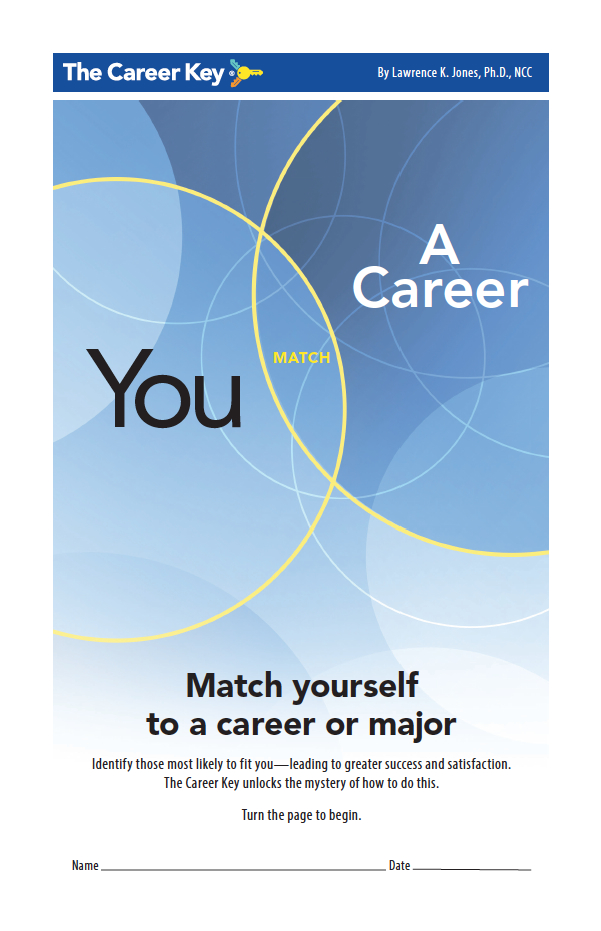
The 20 page, color booklet includes the self-scoring Career Key test, a description of Holland's Theory of Career Choice including the hexagon, and recommended activities with worksheets to further engage in the career exploration process, like:
  • Learning more about occupations
  • Learning more about yourself
  • Creating a career portfolio, and
  • How to make a good decision.

Friday, July 31, 2015

Find your academic tribe! July's Free Agent, the Career Key Newsletter

Is helping others find their academic tribe, the right college major environment on your Fall list for working with high school or college students? Good for you - research says it's worth the extra time to delve into. To read the feature article about it, visit the July 2015 issue of our enewsletter, The Free Agent.  Be sure to subscribe on Career Key's home page, www.careerkey.org, if you like what you see.

The newsletter has Career Key news, humor, and research you can use.  There are links we've come across we think are worth sharing, in addition to free downloads.  Enjoy!

Monday, November 10, 2014

Recent Career Development Research on Physical Disabilities


In honor of National Disability Employment Awareness Month and Veterans Day November 11, I gleaned some practice tips from recent research studies on physical disability and career development.


The goal is to inform and link career development practitioners working with disabled clients to research and resources they may not be aware of. 

Why should we pay attention to disability in career development? 
  1. In 2005, one in five U.S. residents reported some level of disability (U.S. Census 2008) with the number rising with large numbers of returning veterans. 
  2. Individuals with disabilities comprise the largest minority group in the United States, with almost half the population living with one or more chronic health conditions. (Foley-Nipcon and Lee, 2012)
Finding: Severity of the disability and age of disability onset matters

When counseling physically disabled individuals, “the perceived severity of the disability and the point in the life span at which it occurred are not negligible details…”*

Study authors found that:
  • Disability severity and age of onset significantly relate self-efficacy with Realistic, Artistic, Social and Conventional domains. Only the Investigative domain had insignificant relation – perhaps because of its focus “on mental tasks performed alone and that require minimal physical mobility."
  •  “[S]elf-rated disability severity does not have a detrimental relation with vocational self-efficacies among those who become disabled early in life.”
  •  By contrast, “individuals who become disabled later in life show a steeply negative relationship between self-rated disability severity and self-efficacies.”
*Tenenbaum, R. Z., Byrne, C. J., and Dahling, J. J. (2014). Interactive Effects of Physical Disability Severity and Age of Disability Onset on RIASEC Self-Efficacies, Journal of Career Assessment, Vol. 22(2) 274-289.  Note: this study did not include anyone with blindness. Please see any other limitations the authors list.

This study supports recommendations in the diverse populations chapter of NCDA’s Career Development Facilitator “Facilitating Career Development: Student Manual (Rev. 2nd Edition). It recommends that practitioners consider when in the lifespan the disability occurred – taking into account possible feelings of loss, guilt and grief.

Additional resources:
National Career Development Association website’s List of Resources for People with Disabilities

Eby, L. T., Johnson, C. D., & Russell, J. E. A. (1998). A psychometric review of career assessment tools for use with diverse individuals. Journal of Career Assessment, 6, 269–310.

Feldman, D. C. (2004). The role of physical disabilities in early career: Vocational choice, the school-to-work transition, and becoming established. Human Resource Management Review, 14, 247–274.

Foley-Nicpon, M., & Lee, S. (2012) Disability research in counseling psychology journals: A 20-year content analysis. Journal of Counseling Psychology 59, 392–398.

Peterson, D. B., & Elliott, T. R. (2008). Advances in conceptualizing and studying disability. In S. D. Brown & R. W. Lent (Eds.), Handbook of counseling psychology (4th ed., pp. 212–230). Hoboken, NJ: John Wiley & Sons Inc.

If you know of other research or resources I have not included, please leave a comment and I will add it to the post.

Thursday, November 6, 2014

4 Ways Veterans Can Successfully Make the Military to Civilian Transition

To celebrate Veterans Day on November 11, Career Key recommends four strategies veterans can use to make a successful military to civilian transition. They are:
  1. Evaluate your readiness to make a career decision
  2. Use the 4 S's Transition Model for a little structure and self-assessment: Situation, Self, Supports, and Strategies
  3. Explore and narrow career options to personality-career matches using Holland's Theory, and
  4. Follow the 4-step ACIP decision making model.
To see the full details, see press release, "4 Success Strategies for Veterans Making the Military to Civilian Transition" dated October 31, 2014.

Take action now by:
  1. Evaluating your readiness to make decisions using the Career Decision Profile.
  2. Visiting this short slideshow that explains the 4 S Transition Model and asking yourself questions about the 4 S's.
  3. Learning about how to match your personality with career options
  4. Download a free Decision Balance Sheet and watch a short video about decision making at the Career Key website.

Tuesday, September 30, 2014

New Fanshawe College Pathfinder Uses Career Key's Career and College Major Test

We're proud to announce that Fanshawe College, one of the largest colleges of applied art and technology in Ontario, is now using The Career Key's valid career and college major test to match prospective students to Fanshawe's programs of study.  The online Fanshawe Pathfinder is the first college recruitment and admissions tool in Canada and the U.S. to use Personality-Major MatchTM. The Pathfinder gives students valuable information in choosing a program that fits them best and how to make a successful education decision.


Large published research studies show a close personality-major match predicts higher grades, greater persistence in a major, and higher rates of on time graduation. The benefits of this match are described in a free Career Key eBook, Choose a College Major Based on Your Personality.

Fanshawe licensed The Career Key to create the Pathfinder for their admissions and recruitment efforts. The Pathfinder will also be used in academic advising for current students and featured in public open houses and career fairs.


About Fanshawe
Fanshawe’s main campus is located in London, Ontario, about two and half hours outside Toronto. Approximately 17,000 full-time and 26,000 part-time students attend Fanshawe at five campuses. Fanshawe has a demonstrated commitment to student success. Results of the Government of Ontario’s 2013 Key Performance Indicators (KPI) survey show that Fanshawe College is above the provincial average in student satisfaction, graduate satisfaction, and graduate employment (86% of graduates find jobs shortly after graduation). To learn more about Fanshawe, visit Discover Fanshawe.


Wednesday, September 17, 2014

What the Walmart VP Termination Over a Resume Teaches Us


Yes, it teaches us not to lie on our resume, not to leave a misimpression or omission about our credentials.  But why did Walmart’s former Vice President of Communications David Tovar feel the need to demonstrate he graduated from college?  I can’t speak for him but we know the answer… it’s because he needed the degree. You need to graduate from college if you want to make a living wage working for someone else. Like most employers, Walmart will not hire you for salaried sales or management without a college degree (example).
 
Living wage jobs require college or training degrees.
Want a living wage? Want to be a VP someday? Finish college.
I’ve been reading Michael Ellsberg’s The Education of Millionaires: Everything You Won’t Learn in College About How to Be Successful and other anti-college writing. The common position is that people do not need a college degree, pointing to many rich, entrepreneurial people as examples (High-tech company founders, information sales people, etc). And while I found I agreed with Ellsberg on many practical things that are wrong with higher education (and he has some great networking tips), the anti-college argument ultimately fails as a good career planning approach.  

First, a college degree or postsecondary training credential is necessary for most living-wage employment in this country; the statistics about unemployment and salaries do not lie. One reason employers require a college degree or post-secondary training credential in hiring is because it’s an easy way to screen people out, to narrow the hiring pool.  So many people are looking for jobs; employers can afford to be picky. Also, minimum job qualifications like an educational degree are legally necessary in a world where equal rights laws guard against discrimination. So does it really make sense to voluntarily cut yourself off from millions of jobs?

The anti-college crowd argues that you can creatively sell yourself into a job and if that doesn’t work (that employer must be an unimaginative boob), then start your own business. Having been happily self-employed myself at one time, I get the freedom, flexibility and success that can give you.

But self-employment and entrepreneurship is not for everyone. Not everyone has a strong Enterprising Holland personality type, someone who likes to and is good at persuading, leading, and selling things or ideas. Or is an extrovert. And while I agree with Dan Pink and many others that sales skills are needed in nearly every job now, to advise young people that a college degree is unnecessary, substituting sales and marketing skills through self-employment, is a naïve oversimplification of our work world. That's as bad as saying a college degree = a high-paying job.

Self-employment should always be a fallback option, if not a promising option for some. Having practiced labor and employment law for 10 years, I think people should be prepared, as a matter of emotional and financial survival, to be out of a job at any time, for any reason. But being prepared also means having proof of skills and education to support a job search.

Instead of warning people away from college degrees entirely, we can start by helping people approach their college years in smarter ways – identifying majors and programs of study that match their interests and Holland personality, learning more marketing skills, seeking out experiential education programs that don’t require an unpaid internship (that only wealthier parents can afford to subsidize), and adopting a flexible, free agent approach to the world of work.

If Mr. Tovar was so good at his job (it sounds like he was, given his planned promotion), he should not have needed a degree. I believe that it’s what people do, not their credentials, that matter most. But that’s not the economy and human resources legal reality we’re in. I hope and suspect Mr. Tovar will successfully bounce back from his mistake. Tellingly, it sounds like he will start by completing his degree.

5 Tips for Introverts' Success in Career Choices and in School

Introverts face certain challenges to their success at work and in the classroom. Introversion can also be a benefit.  Identifying the right compatible work and school environments can increase your chances of success.
introversion - extroversion
The Introversion-Extroversion Scale with Holland's Hexagon

By combining what we know about introverts with Holland's theory of person-environment match, Career Key author and counseling psychologist Dr. Lawrence K. Jones, NCC gives you five tips for introverts' success in this new self-help article. Find it at the Introverts link above or in our Choose a Career section.

Friday, September 12, 2014

Explore Career Options Using LinkedIn’s New Field of Study Explorer, Especially Liberal Arts Majors


The new LinkedIn Field of Study Explorer is most valuable to students and parents as a tool for exploring possible career options for a particular college major.

It is particularly helpful for students considering liberal arts majors and the humanities because it shows their expansive use in the work world. It’s some form of proof (for skeptics) that jobs do exist for these majors, some with well-known, respected, and well-paying employers.

The Field of Study Explorer has some limitations (see below) but as long as students stick with using it as a “what can I do with a degree in ___” resource, it’s useful.  Here is a short video about how to use it for that purpose.


The Explorer can also be useful for adults changing careers. What else can you do with law degree? Or a massage therapy degree? To what other career fields could you transition that you might not have considered? You may even find connections you could contact for an informational interview.

For more information, students looking at career options related to majors should look on their college’s career services website for a “what can I do with a major in ____” type of page. High school students can look at a nearby state university’s career services website.  The University of North Carolina at Wilmington has a great one as does Kansas State University.

LinkedIn Field of Study Explorer Limitations:

The “Explore More” button has a random selection of majors – they are not related to the one you list in your profile. For example, my major was Politics.  Yet “Explore More” recommended “Home Furnishings and Equipment Installation.” And no, I am not a furniture junkie. So you need to have a “short list” of majors that interest you, ideally ones that match your strongest Holland personality types.

I would not use the Field of Study Explorer to choose a college; in other words, ignore the “Where they went to school” as a limited data set. The more majors a school graduates is irrelevant to quality, even if LinkedIn’s data set were more representative of the U.S. as a whole.

Also see:


Wednesday, June 4, 2014

Choose a Career and College Major with Holland's Theory, New Career Key Video Series

Learn how to choose a career or college major with Holland's Theory of Career Choice in a new YouTube video series "How to Achieve Career and College Success" from Career Key.

These short videos cover Dr. John Holland's six main ideas, including the Holland personality types (also known as Holland codes), Holland's work and education environments, and how to use the Holland hexagon. It's based on the popular Career Key web article on Holland's Theory of Career Choice.

How to Achieve Career and College Success Video Series

  • How to Achieve Career and College Success: Introduction
  • The Six Holland Personality Types
  • The Six Holland Environments
  • Holland Environments: searching for and interacting with them
  • The Holland Hexagon
  • Congruence: Making a Good Match

The series is created and presented by Career Key author and nationally recognized counseling psychologist, Dr. Lawrence K. Jones, NCC. It is followed by a series on good career decision making.

All these videos will appear soon in a new section of the Career Key website.

Subscribe to The Career Key's YouTube channel to get notified of new videos as they appear.

Friday, May 9, 2014

New College and Career Readiness Kit for School Counseling

Career Key's new college and career readiness kit is complimentary, designed for school counselors and other education and career development professionals. In this downloadable kit, we included free eBooks and learning activities related to helping students get college and career ready.


Topics covered:

  • Common Core Standards and school counseling
  • Choosing a college major in high school
  • Learning activities that combine ASCA and Common Core Standards
  • Meeting ASCA National Standards using career and college major exploration activities at the Career Key website.
Finally, there is a link to access a free trial of the Career Key career and college major test (a $150 value).

Related articles:

New Career Key Career Test Launched

Career Key's updated career test is now live! This scientifically valid, career interest inventory has a new design, an updated list of career options and now includes college majors and training programs. The Career Key test now helps those wondering "What should I major in?" There are over 400 careers and 700 majors, easy to explore by Holland personality type and Career Key work group of traits, skills and abilities. Each major is described with a link to external sources to find more information and the colleges that offer the major (no promotions or marketing).

Here is a sample report page:


To learn more about group purchases and the new group administration features, see our Group Purchase Discount.

Tuesday, April 1, 2014

Career Key Test's new version - a video demo for group customers


If you are interested in video demos of the new version of the Career Key test going live later this month, start with this video. It's specifically for Career Key's group customers. For more information about the new version of the Career Key test, visit Career Key's Group Discount page.

Wednesday, March 5, 2014

Holland Personality Type Patterns That Are Inconsistent - and Their Advantages

One part of using Holland's Theory of Career Choice to choose a career is the concept of choosing a compatible work environment, one that matches your strongest personality types. Most people are a combination of types, most often found close to one another on the Holland Hexagon. The hexagon shows the relationship between the types - the closer they are to one another, the more compatible.

But what if your strongest personality types are opposite each other on the hexagon, like Realistic-Social (RS) Investigative-Enterprising (IE), or Conventional-Artistic (CA)? These are sometimes referred to as inconsistent personality patterns. But don't be alarmed.

While these combinations are less common, they are normal. In fact, Career Key's author Dr. Lawrence K. Jones has an inconsistent pattern himself: Realistic-Social. His personal story also shows these characteristics.

To learn more about understanding and taking advantage of these kinds of personality type combinations, visit Career Key's articles:

If you're new to Holland's approach, then start with our Holland's Theory of Career Choice article. We plan on adding a short video about inconsistent personality patterns soon to Career Key's YouTube channel so please subscribe if you want to be notified when that comes out.

Is College Worth It? 6 Ways to Increase Chances of Success in College

More students and parents are asking themselves, is college is worth it? A recent Pew study visualized in TIME magazine finds more people questioning college's value, and yet statistics are clear that it is. The Federal Reserve Bank of New York's 2014 report, "Are Recent College Graduates Finding Good Jobs?" shows compelling reasons to go to college. But the report raises valid concerns about underemployment after graduation and the differing value of certain college majors and skills in the labor market.

Like anything else, research and planning ahead give a big payoff in these types of life decisions.  In Career Key's new website article"Is College Worth It?", counseling psychologist Dr. Lawrence K. Jones, NCC looks at whether people are getting good jobs after graduation based on the latest statistics. Then he recommends how people can increase their chances of success after college graduation.

These recommendations include:

  1. Choose a major that matches your personality and interests.
  2. Consider choosing a major in high school before you choose a college.
  3. Be open to choosing a good job that does not require a 4 year degree.
  4. Have realistic employment expectations; Underemployment is a reality you may have to face.
  5. Be smart and make good decisions about your education plans using an effective decision making process.
  6. Be aware of how the nature of work is changing and plan ways you can respond and adapt.

For more about why college is worth it and what's behind these recommendations, visit Career Key's Choose a College Major section and "Is College Worth It?"